Showing posts with label 2010. Show all posts

Tuesday, June 22, 2010

New coins from Serbia


On 16 June 2010, the NBS will release a 1-dinar coin (made of steel core), 2 and 5-dinar coins (made of copper, zinc and nickel alloy – Cu75 Zn24,5 Ni0,5) and 10 and 20-dinar coins (made of copper, zinc and nickel alloy – Cu70Zn18Ni12).
Apart from designation of “2010” as the minting year, other features of 1, 2, 5 and 10-dinar coins are unchanged. The 20-dinar coin also has “2010” as the minting year, but it now features the portrait of Georg Weifert on its front.
Coins of 1, 2, 5 and 10 dinars will be used in regular cash payment operations, whereas the 20-dinar coin will also serve for marking the 160th anniversary of birth of Georg Weifert, a Serbian industrialist and the National Bank’s long-standing Governor (1890–1902, 1912–1926).

Friday, April 9, 2010

Danmark commemorative coins 2010


Commemorative coin to mark the 70th birthday of Her Majesty Queen Margrethe II on 16 April 2010.
A commemorative coin will be issued to mark the 70th birthday of Queen Margrethe II. This is in keeping with the Danish tradition of issuing commemorative coins to mark special events in the royal family.The commemorative coin can be viewed on a special exhibition in the palace museum in the period 10th April - 1st August 2010.


A new portrait of the QueenThe motif of the obverse of the coin is a new portrait of the Queen by the sculptor Lis Nogel. The new portrait is also to be used on the ordinary 10- and 20-krone coins from 2011 onwards. The reverse was designed by Ronny Andersen, Royal Armorist, and shows the royal coat of arms set against a background of daisies – a reference to the Queen's nickname, Daisy.
1,000-krone gold coin
The gold coin is minted in 900 ‰ gold (Au) with a diameter of 22 mm, a weight of 8.65 g and a nominal value of 1,000 kroner. The recommended retail price for the gold coin is DKK 3,000 incl. VAT.
500-krone silver coin
The silver coin is minted in 999 ‰ fine silver (Ag) with a diameter of 38.0 mm, a weight of 31.1 g and a nominal value of 500 kroner. The silver coin is sold at its nominal value.
20-krone coin, ordinary version1.2 million ordinary circulation coins will be minted and sold in rolls of 20 coins each.

Thursday, April 1, 2010

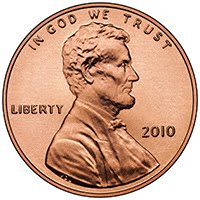
2010 Lincoln one cent coin


The current Lincoln cent's reverse (tails side) design is emblematic of President Abraham Lincoln's preservation of the United States as a single and united country, as required by Title III of Public Law 109-145, the Presidential $1 Coin Act of 2005. While the obverse (heads) continues to bear the familiar Victor David Brenner likeness of President Lincoln that has appeared on the coin since 1909, the reverse features a union shield with a scroll draped across and the inscription ONE CENT.
The 13 vertical stripes of the shield represent the states joined in one compact union to support the federal government, represented by the horizontal bar above. The horizontal bar features the inscription E PLURIBUS UNUM—"out of many, one"—while the inscription UNITED STATES OF AMERICA is depicted along the upper rim of the coin. The union shield, which dates back to the 1780s, was used widely during the Civil War. The shield is also featured on frescoes by Constantino Brumidi throughout the halls of the U.S. Capitol Building completed in the mid-19th century.
The Secretary of the Treasury approved the reverse design for the coin after consultation with the U.S. Commission of Fine Arts and review by the Citizen's Coinage Advisory Committee.
These one-cent coins have a metallic content of 2.5 percent copper, balance zinc. They are issued for circulation in quantities sufficient to meet the demands of commerce. Numismatic (proof and uncirculated) versions are included in the United States Mint's annual product offerings.


Source US Mint

Wednesday, March 3, 2010

Swiss 10 francs 2010


The Alpine MarmotThe nimble marmots never cease to fascinate the many visitors hiking in the National Park, whether for their cute manner, shrill whistling or scraps reminiscent of exhibition fights. In the harsh mountain climate, the marmots only find enough food to sustain them from May to September. In order to survive the six-month winter hibernation, during the summer, they eat to build up a thick layer of fat. At the beginning of October, the marmots retreat to their well-padded dormitory. By reducing body functions, their energy consumption drops to one tenth of its normal level. Marmots spend 90 per cent of their lives in their extensive networks of burrows, safe from the cold and predators. They establish several entrances to enable them to beat a hasty retreat. Thanks to their sense of touch, marmots are very much at home in the dark.Marmots live in family groups, each with an adult male and female as well as several young animals. In May, 34 days after mating, the female gives birth to between two and six naked, blind and deaf young, each weighing around 30 grams. The habitat of our Alpine marmots extends from the Alpine meadows above the tree line as far as the glaciers. In the National Park, they are especially common in the Val Trupchun and on Munt la Schera.
The bimetal coin 2010 'Swiss National Park – Alpine Marmot' at a glance
Date of issue: 21st January 2010
Design: Niklaus Heeb, Rodersdorf

Coin image: Alpine Marmot
Legal face value: 10 Swiss francs
Alloy: Cupronickel + Aluminium Bronze
Weight: 15 g
Diameter: 33 mm (Core 23 mm/Outer ring 33 mm)
Uncirculated: Max. 94,000
Proof: Max. 12,000
Source: Swiss mint

Monday, February 15, 2010

Ole Bull 10-krone Norway commemorative coin 2010


Ole Bornemann Bull was born on 5 February 1810 in Bergen and died on 17 August 1880. A celebrated Norwegian violinist and composer of international renown, his impassioned dedication to traditional Norwegian folk music played a prominent role in the development of a distinctively Norwegian culture following the dissolution of the union with Denmark in 1814.
In the course of his long career, Ole Bull travelled extensively, performing all over the world, and composed a total of more than 70 works, including Recuerdos de Habana, Et Sæterbesøg, Sætergjentens søndag, I ensomme Stunde and Polacca Guerriera. He also supported and encouraged young Norwegian classical musicians such as Edvard Grieg, Erika Nissen, Agathe Backer Grøndahl and Rikard Nordraak.


Design and technical specifications
Diameter: 24.0 mm
Thickness: 2.0 mm
Weight: 6.8 g
Alloy: 81% Cu, 10% Zn, 9% Ni
Edge: Alternate plain/milled


Obverse (heads side):
The obverse features a portrait of H.M. King Harald V facing right. Around the portrait is the inscription: HARALD V NORGES KONGE. At the lower left edge of the portrait is the artist’s signature, IAR. Below the portrait is the year 2010 with Det Norske Myntverkets (Mint of Norway’s) mintmark, the crossed pick and hammer, placed between the first two and last two digits.


Reverse (tails side):
The design on the reverse features Ole Bull’s portrait fused with part of a sheet of music from his composition ”Seterjentens søndag”, one of Bull’s most famous compositions, with his name (OLE BULL), the anniversary year (200 ÅR) and the coin’s denomination (10 kr) to the right. These elements form a decorative and rhythmic whole. Below the denomination is the designer’s signature, WG.


The coin's obverse was designed by Ingrid Austlid Rise, designer at Det Norske Myntverket AS (Mint of Norway). The reverse was designed by sculptor Wenche Gulbransen. 10-krone coins in the standard design will not be issued in 2010.


Source: Norges bank

Friday, January 29, 2010

The Lincoln One Cent Coin 2010

The current Lincoln cent's reverse (tails side) design is emblematic of President Abraham Lincoln's preservation of the United States as a single and united country, as required by Title III of Public Law 109-145, the Presidential $1 Coin Act of 2005. While the obverse (heads) continues to bear the familiar Victor David Brenner likeness of President Lincoln that has appeared on the coin since 1909, the reverse features a union shield with a scroll draped across and the inscription ONE CENT.
The 13 vertical stripes of the shield represent the states joined in one compact union to support the federal government, represented by the horizontal bar above. The horizontal bar features the inscription E PLURIBUS UNUM—"out of many, one"—while the inscription UNITED STATES OF AMERICA is depicted along the upper rim of the coin. The union shield, which dates back to the 1780s, was used widely during the Civil War. The shield is also featured on frescoes by Constantino Brumidi throughout the halls of the U.S. Capitol Building completed in the mid-19th century.
The Secretary of the Treasury approved the reverse design for the coin after consultation with the U.S. Commission of Fine Arts and review by the Citizen's Coinage Advisory Committee.
These one-cent coins have a metallic content of 2.5 percent copper, balance zinc. They are issued for circulation in quantities sufficient to meet the demands of commerce. Numismatic (proof and uncirculated) versions are included in the United States Mint's annual product offerings.

Source: US Mint

Saturday, November 21, 2009

Australian two coins 2010 Burke & Wills


2010 will mark the 150th anniversary of the Burke and Wills expedition, and subsequently the Royal Australian Mint themes its newest set to honour these explorers. The new $1 and 20 cent coins will feature in the two coin set in both uncirculated and proof finishes.
The $1 coin spotlights the hardships endured by the Burke and Wills expedition team. Here we see the weary remaining sole survivor of the expedition resting under the iconic carved dig tree on Cooper’s Creek in southwest Queensland. The 20 cent coin design depicts Burke and Wills astride camel and horse, departing on their epic journey.
The camel tracks represent their south to north travelling route, while the footprints narrate the aid of the Aboriginal people, as well as the Indian, Afghan and Pakistani cameleers. The lustrous proof finish shows off the criss-crossing footprints of humans and camels, representative of the pioneers incredibly arduous journey.

Thursday, November 5, 2009

Russia 3 Rubles 2010


The silver coin of 3 Rubles denomination of the series "The Lunar Calendar" featuring the Tiger (fine metal content 31,1g, fineness 925/1000, catalogue number 5111-0190, diameter 39,0 mm, mintage 15000 pcs ).
The obverse: the relief picture of the Emblem of the Bank of Russia - the two headed eagle with wings down, and the semicircular inscription under it "БАНК РОССИИ" (BANK OF RUSSIA). The inscriptions along the rim divided by dots indicate the denomination of the coins "ТРИ РУБЛЯ" (THREE RUBLES) and the year of issue "2010", between them - the indication of the metal sign in accordance with the D.I. Mendeleyev Periodic System of Chemical Elements, the fineness, the mint trade mark and the fine precious metal content.
The reverse: in the centre of the coin - the relief picture of a tiger, to the right - a matted image of the half-moon.

The edge of the coin is corrugated.